The Logical Philosopher

Sunday, June 03, 2007

Is the Dunbar Theory applicable in a Web 2.0 Society?

The Long tail of Social Networking and the Dunbar Theory, with the Logical Philosopher and Gaping Void So what is the true purpose of social networking? Apart from keeping the labor lawyers busy with defending slanderous and malicious wall-to-wall writings, it also serves as a portal to reconnect with old friends, and meet new ones. Or does it? It actually changes our neocortical processing capacity, seen in our ability to connect with a finite amount of people at within the neocortex level in our brain – something that has been limited since the Neolithic age.

That poses an interesting social question: Can Web 2.0 undo 6000 years of evolved social limits?

It worries me that several of my last posts have been about Facebook. Yes, a time waster for all of us, but for me it provides a mark of how much more I am online, as compared to out people watching downtown for great blogging stories.

I find it funny that people on my list that I work with don't acknowledge the existence of it while at work. It's like "What happens in facebook, stays in facebook." I am sure that will all go to hell when something really good gets posted on facebook.

On the topic of reconnecting with old friends, someone said it best to me when they said "I haven't heard from these people for 10 years - why seek me out now, other than to boost their friends count?" As such, I was discussing the philosophy of facebook with Sandritia last weekend, and we came to an interesting point in our analysis.

Social Networking really provides three types of friendships:

1) A pure virtual friendship - no maintenance required, apart from the occasional poke. It is available 24/7 and can reach all corners of the networked globe, connecting individuals with the same obscure interests. Like any digital community it gives an arms-length form of a relationship, allowing us to morph in and out of a digital character, whether it be a true mirror of ourselves, or a made up avatar.

2) A reconnection of friendships – old acquaintances that you just lost touch with, but if you knew where they were, or what they were doing you would be sure to drop in and visit when you were in their part of town. But like any double edged sword this also includes acquaintances that you were glad to lose touch with.

3) New analog friendships, but with the social networking add-on. Instead of meeting somebody once at a social gathering, you now have the ability to keep tabs on what they are doing until you meet at another, real world, social gathering. Effectively accelerating the “getting to know you” from three or four meetings over a few weeks (or months) to twenty or so digital updates within a few days.

In reality we can only genuinely keep up with so many friends. Speaking from a sociologist’s point of view, there is an actual theoretical numerical limit to which we can reach where we begin to lose track of the social relationships with each person, and how they relate to everyone else we know. Highlighted in Malcolm Gladwell’s Tipping Point, this theory is seen as one of the central pillars of the Power of Context: The Dunbar Principle.

Dunbar’s research was measuring the “cognitive limit to the number of individuals with whom any one person can maintain stable relationships.” The research looked at a variety of settlements over centuries of social data: Hutterite settlements, army sizes in both current state and as far back as Roman times, and even settlements reaching back to Neolithic farming villages. His conclusion was a human group size of no more than 150 people.


Facebook and Myspace: Social Networking and the Dunbar Theory with the Logical Philosopher Ten years ago I would have suggested that most of us would be hard pressed to name 150 close social friends. In reality work colleagues, relatives and family took up a good portion, with the remainder being our social friends. But now? I’m not so confident of my suggestion. In the past year there has been a boom of social networking sites: 43 Things, Facebook, Myspace, Linked-in, Bebo, Friendster, Hi5, Livespace, etc… Not only do these sites allow us to keep track of our current friends and acquaintances, but more importantly they allow us to retain a connection to those we would have lost touch with when we moved on from a job, a school or a city.

Now, although I’m going to mention the word “statistical distribution”, trust me, this is where it gets interesting.

Long tail economics refers to the statistical distribution of high-amplitude populations followed by a tail of low-amplitude populations. It provides interesting model to look at social networking through – we now have a long tail of friends. They are no longer gone, but only a few Google clicks away of being found.

Mixing in the long tail economics with social networking it begs the question: Can Web 2.0 change the social dynamics of our social contacts enough to significantly change the way Dunbar’s Theory can be approached?

Yes – and it is already happening. It is like we all just got an expansion card for our neocortex, complements of the computer. And if you lose your card, Google will be there to archive it for you. Like it or not, I think we all just took one large step towards living in the Matrix.

If you are a Sociologist and want to explore this more, give me an email. I think we have the makings of a good research article here.

Monday, May 14, 2007

Web 2.0 - the video version

From Blogger to Digg, Facebook to Delicious - the knowlege management aspect of social networking is becoming another research interest for me.

On that topic, here's an interesting video I found on Martin Dugage's blog about Web 2.0


When you think about it, it makes web 2.0 like a happy version of the Matrix. Pass me over some of those red pills so I can see for sure.

Saturday, October 07, 2006

Brain candy for inquiring minds


Last week I had an academic epiphany - free knowledge for the masses, all thanks to Google and YouTube. Google Video has a vast list of videos to expand your knowledge base - academic lectures, Google Authors and Google Tech Talks. Some are great talks: Ron Avitzur's story of how he snuck into Apple for 6 months and worked for free on a then cancelled secret project that was later released into 20 million computers. Or Warren Buffett's talk to MBA graduates at the University of Florida.

My favorite Buffett quote "[when you graduate] work in a job that you like, not that looks good on your resume. Because isn't that like waiting for sex until your old age?"
My goal is to post the links to expand ones knowledge base. It's like going back to school, but from the comfort of your computer chair! And, if you don't like the professor, they won't notice if you skip ahead with the forward button.

I hope to post something you all will enjoy. Check it out:

http://googleuniversity.blogspot.com

Like I said, brain candy for inquiring minds.

Sunday, October 01, 2006

Social Neworking: Digg and Blogger Beta Users Are Still Early Adopters

Social Networkers Beware: Anecdotal proof that Diggers and Beta Bloggers are still the geeky Innovators and Early Adopters that we think we aren't.

If you Digg, Reddit, Furl, Delicious, Blog, or generally do more online social networking than offline, you probably think everyone else does it. You are vaguely aware of people that don't know what Social Networking is, and wonder where those people have been living. It's mainstream, you think. However we really are still in the Early Adopter phase of the internet's social networking boom.

Microsoft claims they own over 80% of the global browser market share - but that takes into account the market as a whole. This view is skewed because when you dig deeper you find all technology marketing managers actually split the market up using Diffusion of Innovation Theory. This split is seen as five technology adopter categories - innovators, early adopters, early majority, late majority, and laggards. If you look at each market individually, the claimed 80% market share is probably split very differently; my guess the IE market share being weighted greater than 90% for the Early/Late Majority, and less than 40% to the Innovators/Early Adopters.

I recently deviated from my usual posts and went technical, posting a piece entitled Getting Haloscan to work in Beta Blogger. After switching to Beta Blogger and spending many hours of struggling with this specific technology issue before getting it working, I thought it would be nice to give back to others. Almost immediately my web hit counter went up by about 200, most of them directly going to this post either from a search engine (mainly Google), digg link or another blogger referral. Considering the combination of Blogger Beta and Haloscan users is probably not that large, I found it interesting that over the next 2 weeks I had at least two thousand more hits on this single post. What I found even more interesting was about the browser usage, which I pulled from my Google Analytics account:

  • 64% Firefox
  • 27% Explorer
  • 9% Other (Netscape, Opera, etc.)
Ironically this also lined up remarkably well with AUInteractive's recent post 64% of You Use Firefox. Regardless of where they came from - Digg, external blogger link or a search engine, the numbers still were overwhelming leaning towards Firefox.
Doesn't this data fly in the face of Microsoft's claim of dominat market share? Firefox even agrees they only have a small portion, 10-15%. If so, why?
Look at Firefox's initial market when the launched their first browser: they started by luring the Innovators and Early Adopters away from IE. Are they still doing that? If not explicitly I would suggest they are at least building on their base of Innovators/Early Adopters. Now considering my Google Analytics results I would think there probably is some statistical correlation between browser usage and Digg/Blogger users. This means that there is also a correlation between Digg/Blogger users and the adopter categories of Innovators & Early Adopters.

While the connection is loose, it still gives some general observations:

  • If you are reading this with Firefox you probably are a geek: Social Networking is still in it's infancy. Innovators and Early Adopters still rule, and they rule loudly with Firefox. (Remember, being a geek isn't a bad thing - look how Bill Gates turned out, even if he doesn't use Firefox)
  • Marketing folks take note: Blog & market your technology accordingly! Even this informal data helps define the target market for Diggers, Reddit and Blogger Beta folks.
  • Internet CEO's beware: There is an upcoming "chasm" Social Networking companies need to worry about.

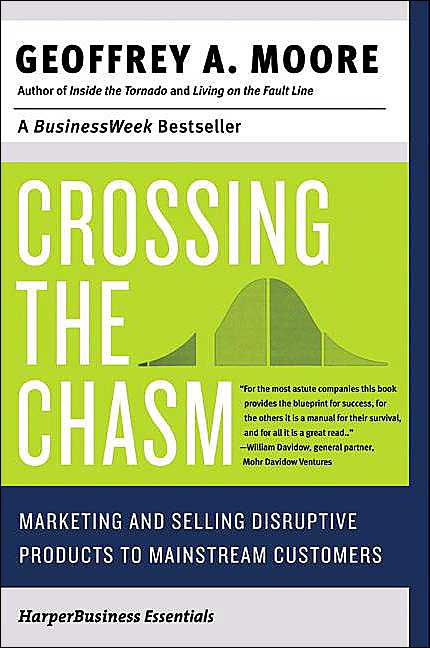
What can we do with these observations? I've been thinking about starting some focused social networking sites, but always had the feeling that the market was getting too crowded. The Paradigm Shift posted a blog last week entitled 300+ social network startups in less than 2 years. Historically, technology companies have had a difficult time "Crossing the Chasm" from wooing customers in the Early Adopters market to getting new ones in the Early Majority market.

Just for the record, I use Blogger Beta, post Del.icio.us items, Digg things, all while surfing with Firefox. I am also an Early Adopter.

Current and future CEO's of the Social Networking sites need to take note - there is probably a virtual Chasm for your technology as well and only time will tell how many of those 300+ will actually make the leap. As for me it will mean more market research and technology development before you see the launch of my next site.

Now if you use Firefox, prove me right and go digg me.

Saturday, August 26, 2006

Accession of Knowledge: Part II

It has been over a year, but I finally have posted part II. See here for Part I.

If you recall I postulated, in the context of our knowledge economy in the information age, why we are too busy working to get any work done. Why? With RSS aggregators email and other technologies to pass us information the instant is it written, there is becoming too much information to filter out. We can spend all day working, filtering information and passing it to others, but in the end we have not moved forward to our end goals. No closer to finishing that business proposal, strategic planning article or personnel reviews.

So I asked: What is the balance between knowledge & forward progress?
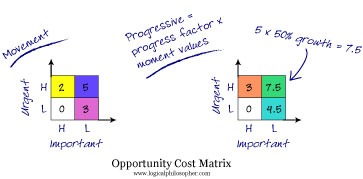
To answer this we consider the Urgent vs. Important 2x2 matrix. I suggest a third dimension of Growth is what we need to introduce in order to understand the balance of forward progress and "just getting things done". I refer to this as the "Opportunity Cost Matrix" (see figure below)

In order to determine how we can get more done, and what to focus our priorities on, we need to understand that with this 3D matrix, as we move from working on High Urgency, High Important tasks that will offer our company (or project) high growth rates, there exists a problem when we move to working on other tasks. What is the second more important task? Something that is high urgency and low importance but offers high growth? Or something that is high urgency and high importance, but won't offer much long term growth to the project.
That problem is what I want to consider here.


Research Question:

How does our firms Growth Rate impact our priortization of tasks?

What is the opportunity cost of doing movment based activities over progressive activities?

When should we focus on “Low Urgency” progressive tasks over “High Urgency” movement tasks?


Defining:
Movement = nominal firm growth; target existing sales, general business tasks; status quo.
Progressive = agressive firm growth; target increasing sales, business development & implementation.
Progress factor = opportunity cost (or growth rate) of doing ‘movement’ activities over ‘progressive’ activities.

Now we need to break this down into how we should prioritize things - and I will do so as an example. I will use “progressive” tasks give a 50% firm growth rate over donig “movement” oritented tasks (10 points allocated across matrix). This gives:


This shows the priority of getting work done is as follows:
1) Progressive based High Urgency, High Importance tasks
2) Movement based High Urgency, High Importance tasks
3) Progressive based Low Urgency, High Importance tasks etc...

Plotting this we see:
  • If (Progressive Growth Factor) Less Than 67%, focus on movement of high urgency items over progress of low urgency items.
  • If (Progressive Growth Factor) Greater Than 67%, focus on progress of low urgency items over movement of high urgency items
What does this mean? The Key Success Factor for high growth startups or projects is to focus on the “Progressive” tasks. In other words if you work for a mature company, your time is actually well spent by doing the boring monthly report for your CEO instead of the more fun, blue sky strategy planning that you do in a startup.

Next steps:
How does a different task point allocation alter the model?
How do we actually calculate the progress factor?

Wednesday, March 22, 2006

Do your own frickin' work

I now will take a break from my regular posting to provide this educational lecture on university ethics:

Judging by the huge amounts of recent google searches for SABRE Simulation that have shown up this week on my blog, some MBA program out east is using the Simulation in their classes. All those hits pointed to an older post I wrote about Business Simulations and the future of MBA programs, with several of the searches googled on "Sabre Simulation takeaways".

To those that have come here searching for take-away points for your business course: Dude, do your own frickin' work! Searching the internet for answers to a case study is a sure fire way to piss off your classmates.
I had a friend going to Rotman who was doing his MBA at the same time as me. During one particularly crazy week of group case study take-home finals he was lamenting to me that all one of their group members did was surf the net for "answers" to put into their case. He basically wasted the allotted 8 hours emailing friends and googling for online discussion or commentary about the case....and still came back with nothing useful. He was pissed at him for wasting his time when he could have been helping further their assignment. "No future reference for him!" was the phrase that I recall hearing.

I had a similar situation happen to me during my MBA and sure enough, when time came to form groups later on during classes that really mattered, lazy classmates that needed the internet to do their work for them unexpectedly (for them) found themselves without a group and had to do the work on their own. Boy, was he surprised that we didn't want his "help" in our group. He called it "valuable research" but one prof called it "plagiarism".

To my usual readers, regular posting will commence shortly.

To those still looking for MBA case study takeaways, look here.

Wednesday, February 08, 2006

Jackpot: I've hit it big time!

"I sound my barbaric yawp over the roofs of the world"
- Walt Whitman

Holy yawp! I won! Finally, after 5 months of blogging I have finally turned my blogging trade into a pretty profit. Well, technically that would depend on how you define profit, but I'm not that picky now a days.

Last week the Phantom Professor (one of my semi-daily reads on the right side) issued a word nerd challenge - Write a 10 line play. Feeling some literary friskiness in my fingers I scurried away into my library and spent countless hours writing, drafting, editing and re-writing. It was a very Dead Poet's Society-esque type experience for me, but unfortunately really didn't elicit any manuscript I would want to pen my Logical Philosopher nom de plume title to.

With an impending deadline and my creativity slowly being crushed by a monumental chunk of writers block, I did what every engineer was taught in first year: copy what you did on the last assignment! Who knew 10 years later my engineering undergrad would give me skills to actually write something! With the quasi-orgasmic creative burst only a seasoned litterateur could muster I redrafted my previous "Proof Evolution can go in Reverse" post to make the 10 line cutoff. With that a weight was lifted like no other I had felt before.

For all my efforts I was picked in the top 3 and will receive my prize of a journaling book - perfect to use as an analog blogging journal while on the bus. A new, stealthy book will be welcome because all my friends have started to figure out which book I write my blog drafts in and seek to hide it when I come to visit.

As an aside I would encourage each of you dear readers, and with my statistics tracking I know there are a few regulars now, to have a look at my "daily read" links. Some of them are quite humorous and enjoyable to read. Honest, I just don't link for the fun of it - they are vetted through a rigorous supreme court like conformation program, just with less media attention.
My recommended top 3 reads of this week! If you have little time to read make sure to at least checkout Dooce, Grumpy Teacher and Mini Proportions. I am sure you will agree Grumpy Teachers story of his first massage and the accidental boner is quite riveting....
Thanks Phantom Professor, I am looking forward to my journal so I may continue my blogging drafts wherever I may be in my daily travels.

Thursday, January 19, 2006

Moving from blogging to writing

Shifting from Blogging to Writing: payoff or payout
Since I started reading several online blogs over a year ago I have noted a slow but sure movement of print publications emerging by bloggers. It's almost as if us bloggers are Clayton Christensen's Disruptive Technology of the writing world. Finally, an applicable analogy from my MBA that I can use in my blog for real. How cool is that.

I often wondered if people could turn blogging hobbies into writing occupations successfully - and now I am sure one can. In support of my statement I refer you to Dooce and Kottke - both quit their day jobs well over a year ago to blog full time. A few other high profile notables include:
Payoff up and coming: Today, Opinionistas unveiled the real person behind the anonymous blog - and as my blogging partners and I privately suspected she wasn't some 50 year old disgruntled male at a NY law firm. Not to disappoint she came out of the blogging closet as a 27 year old female lawyer, moreso disillusioned and disappointed with her career direction. And, contrary to the 50 year old, balding male we all suspected, she was hot, long haired brunette to boot! Her next step, after quitting her job, is to devote more time to sleep and her novel, the latter based on her blog. No cash flowing in (yet) but with the existence of a literary agent on her contact info, you can be sure it will be coming.

What about cash flow NOW? Read the small print on Heather Armstrong's website (Dooce). This professional blogger charges $390/month per advertisement and by my guess by her ad count & space that gives, on the low side, $5k/month in revenue. Now, at 75,000+ hits a day I would assume there are some large hosting costs to navigate but still, that's pretty good cash flow. At my daily hit rate I estimated it will take me about 20 years to get that good. So much for me having cash flow now.

"What do you really want to do?"
"Let's just be writers and live a life of luxury."
"Um..."
"Yeah, that was probably the dumbest thing that ever came out of my mouth."
Swiped from Dooce.com (
September 2004)


I probably outline 6 or 7 stories a week, but only 2 or 3 good ones make it to the blog. I alternate between contemplation and writing, interjected with several rounds of refinement. The goal is to crescendo into a literary fever which hopefully makes me sound like the philosophical, bibliophile person I wish I (sometimes) was. This translates to 3 or 4 hours to distill a rough thought into an appealing and entertaining post. As for cash flow this means at $5k of income a month I would be paid $100/hour to blog. Holy crap - How do you like 'dem apples...

For me, it's still payup time as I wrestle tirelessly with my perceived lack of writing talent. Yes, five years of engineering and drafting patents will degrade anyone's writing skills, but my MBA hopefully resurrected some flowing prose that runs in my family:

  • Engineering work made me write simple, short & to the point.
    i.e., John drank beer with his friends after dumping his girlfriend.
  • Patent drafting work made me write long winded fact based content with 1 long paragraph as one legal sentence . Need 1 entire page as 1 sentence? I was your man!
    i.e., John drank copious amounts of beer from a round and tall glass, while at the bar with his friends, all the time while Mary waited patiently at home in her kitchen, baking cookies and hoping that John would be home in time for dessert instead of leaving her for the other women in his life like he had discussed on the phone earlier that evening...
  • MBA made me learn how to not write short, nor an entire paragraph as one legal sentence. Flowing prose with the occasional "synergy" and "strategy" terms thrown in for good measure.
    i.e., John was drinking again, toasting new found freedom with his buddies at the local bar. "I told her tonight", he boasted. "She's out of my life but somehow didn't get it." "I heard she's still at home baking cookies for you," piped up Martin, pouring another round for the group. "Yep," John noted, his attention wandering towards the new group of ladies that entered the establishment. "But you know what they say - you can look at dessert as long as you come home for dinner. Well, I'm a dessert for dinner kind of guy, you dig?"

Now which one would you rather read? Thank God I did my MBA but in retrospect you'd think I would have learned it would have been easier not to learn writing three different ways...

Maybe, yes, one day in the distant future I will hit payoff but that's not the point or goal of this blog. Rather it is to write some contemplative and amusing stories for some of my family & friends. If any others get entertained, inspired or motivated to do something, all while giving me a outlet for some of my recent experiences, I'm happy. If you like my posts and blogroll, link or pass them on, I'm really happy - like a fat kid on a smartie!

Besides writing this gives me a real reason to read other blogs. "It's not entertainment I'm surfing the web for honey - it's research!" "Yeah, whatever. Just go change the dirty diaper".

Thursday, December 15, 2005

Managing Intellectual Property & Business

I was asked to write a short summary of an article with some commentary, so I thought I would post it as well. I based the summary on an article entitled Intellectual Property - from Management to Litigation, as published in The Deal on April 25th, 2005. A PDF of the article can be found here on the Brinks Hofer Gilson & Lione website.

Several months ago the Grokster case was argued in the US Supreme Court. This 2005 case was to our digital generation to what the Betamax case was to 1984. The Betamax case answered for the affirmative when looking at if Betamax could be used for substantial noninfringing uses and thus legal for Sony Corporation to sell. Now we have new digital music and video files capable of being transmitted over any remote digital network. This means the issue, albeit more technical, appears to have come up again but in reality the peer to peer based Grokster case needs to be viewed from a different perspective than Betamax was. The content owners, who claim their intellectual property is being given away for free with these file-sharing sites, realize they can't stop technology and thus are simply trying to limit their use.

Balance between intellectual property protection and innovation can best be viewed through a blending of economic, intellectual and legal issues.
First, one must consider the fundamental reason for intellectual property protection was created to ensure the protection for innovators - through legal avenues inventors are given economic incentive to continue to invent. But at what point does old protected innovation stifle new innovation? Open competition is also required to prevent unhealthy economic monopolies and stimulate more business. It is this perspective of "fair use" that most proponents of technology over intellectual property state their cases on. As the global economy is starting to shift to more of a knowledge base economy, the there is a need for proactively managing a company's intellectual property protection and exploitation, instead of reactively managing within the marketplace.

To add a third dimension of complexity to the issue of protection & innovation the growth and change of a company's structure in today's working global environment should be considered. This suggests for mergers and acquisitions the intellectual property (IP) of a company is becoming more important to consider. One reason is due to the increased knowledge economy of software and other intangible literature. The second is some firms that are up for acquisition may not realize the potential of their IP, instead being too focused on their tangible products and their markets. IP also extends beyond the traditional business merger and can be used for two competitors to create a larger user base and thus a potential standard to which they can both benefit instead of fighting for the existing customer base. A third is the realization that global business is a necessity to stay competitive. Global outsourcing mixed with differing intellectual property legal protection across country jurisdictions can create a complex environment to structure an acquisition. Having IP enforced or protected differently in multiple jurisdictions where certain portions of a company's operations reside may impact the way product or services can be handled.

But with the cost associated with acquiring IP, one must be willing to enforce it.

One obvious component in enforcement is litigation, which has showed no signs of weakness in the past few years. While new technology cases such as Grokster are expanding into unchartered legal territory, many of the recent cases have honed current law. Recent casts have been clarifying more mundane, but necessary, portions of IP law, such as claim construction and willful infringement.

The most recent willful infringement case, the Festo case, deals with the issue of treble damages when a corporation is held to have willfully infringed a patent. Historically part of a successful defence to treble damages was to produce a good faith non-infringement opinion of counsel. This caused an issue of adverse inference for defendants if they chose to not use counsel for an opinion, or reveal the opinion in court. This means the judge or jury could assume an opinunfavorablevourable and award treble damages. With Festo eliminating this adverse inference rule, companies have larger legal latitude in their handling of potentially infringing patents at the time an opinion is drafted.

The recent Phillips case relates to the issue of claim construction. Presently claim construction is taken as a matter of law and defined by the judge and dictated to the jury. But with this being a point of law it resulted in over 50% of the patent cases tried in district court being overturned by the court of appeals. With a $2 to $5 million cost to take a case through litigation, it posed huge financial uncertainties for parties of the court as it moved to appeals. After accepting amicus briefs the Federal Circuit panel issues it's en banc ruling giving a detailed recitation of claim construction principles, but it did not address the differences applied to the district courts over the federal courts. This infers the issue of large amount of reversals in the federal courts may still stand for the time being.

So where does this leave us?

There are two common ways to manage a firm's intellectual property - from the business perspective of products and markets, and from the focused legal perspective of asset protection.


Within both views the goal is to ensure any existing IP is being utilized to its full potential. In either case IP is a complex issue to deal with and should not be considered as an afterthought or add on to corporate growth and strategy. Strict interpretation and enforcement of IP law is becoming more fluid as technology continues to evolve and mature, leaving many IP issues such as open-source software and peer-to-peer programs unguided by the courts.

As the courts and legal field have typically move slower than the technology growth of our generation, I suggest it will provide an interesting wild west type free for all at least for the next few years of IP business.

I think I'm gonna get me one of them there patent six shooters when I get back to work.

Thursday, December 01, 2005

Accession of Knowledge: Part I

The growth pattern of the knowledge economy is staggering. I recall a quote by Dr. Nick Bontis (Associate Professor at DeGroote in Strategy) that when we were in grade 2 the amount of knowledge in the world had doubled since our birth - now it is something like every 10 minutes. With the exponential growth of citizen journalism, blogs and readily accessible google based knowledge I can see his point... I subscribe to several RSS feeds in my field of work and I could honestly spend all day pouring over new posts & legal opinions which would, in theory, help me make better informed decisions in my workplace....and I don't subscribe to that many, less than 10.

An interesting article on how RSS is evolving in the knowledge based environment is Feedburner's "Burning Questions" Feed for Thought post on how RSS and Blogs have changed in the past 3 years. At inception they RSS was mainly a blogger tool but now has expanded to web services, commercial publications and even news articles for major news networks - this shift is important to note because it allows users and publishers to keep updated on new knowledge articles as they are posted to the web. It's almost like the subversive Naomi Klein-esque No-Logo backdoor version of the information age's marketing. It will be interesting to see how corporations begin to capitalize on this, for example in a few years I can just see the local RSS feed for McDonald's when their menu changes... But I digress...

Now, in another breath, take the decentralized power of the internet. With services such as Cafe Press' Self Publish Books I can do things like type a book, upload the PDF and *poof* anyone can buy my purchase and it is printed, bound and shipped on a 1 of basis...I suspect this is a sure fire way to make some money on my thesis, but I digress... again.

You know what this really means: There is an abundant pile of "knowledge-crap" out there.

My thoughts on this really came to culmination when I read an article in today's Financial Post. It brought to light how several (or most) of the well-to-do hedge fund managers actually ignore and avoid most of the available broker research (Nov 28th - Broker research a Tough Sell on the Street). Why? Too much crappy information out there. If a hedge fund manager making $1 Million a year has figured this out, I'm looking for a raise in my life salary...

Now consider these two topics - the continual exponential growth of the knowledge base (supported and accessible via the internet) and the fact that anyone, anywhere can offer services that 20 years ago would have required a small mortgage and publishing army I am starting to get to the point where I am actually getting too much information to filter out. There are days when I feel like all I do is field work emails for press releases people think I am interested in along with reading up on new technologies or progress in my field that happened that day - no forward progression of my corporate goals are done.

One can work all day moving the company forward, but doesn't actually offer any corporate progress towards its end goals.

So what's the balance between knowledge & forward progress? I have a theory, but it's going to take considerable more thought to get it down in a coherent fashion for commentary. I thought I would use today's post to set the stage. Suffice to say academia will be proud as it is a 2x2x2 matrix with some charts and statistics. In the mean time if you are interested in seeing Part II be posted or have any thoughts drop them in the comments box and I'll see if they are addressable in my theory.


###

Sunday, November 20, 2005

The quagmire of the 598

In a perfect world I would be a student forever. Yes, the pay isn’t great but I love the hours, the freedom of choosing my knowledge intake for the semester, compounded by the reality that I get to learn and create cool stuff almost every day. In fact every time, almost without fail, when I go onto campus I get that feeling like it’s Christmas day and there’s a boat load of presents under the tree just waiting for me. I was on campus last week and got that very feeling…tingly all over.

Why are there people like me that actually enjoy grad school? Well consider this - the utopian academic environment is neatly sliced into 13 week segments with at least 3 weeks of holiday before starting all over again. This gives ample free time to hang with friends and other students while consistently indulging in Starbucks in a bohemian style fashion. How cool is that.

However, as we move from student life to professional life, things change. We move to the realization of being gainfully employed by “the man” and actually having to be at work from 9 to 5 every day. No more “cutting work” if we are up too late having a good time and, my personal disappointment, no more hypothetical and esoteric discussions in a clean, quasi-orgasmic intellectual environment on how we would solve the world’s problem of the day. I always enjoyed solving a complex business problem and presenting it in four neat slides to the class – without actually having to implement the plan. In real life the plan’s good, but those details will kill you. Yes, there is a reason I took 18 months longer than the rest of my class to graduate.

And just so you didn’t think I’m the only person dragging out things, I give you with a story of my friend Sandrita. Starting another graduate program similar to mine Sandrita was also required to do a final thesis – but the catch here is that I stated my program 2 years after her and Sandrita had all her coursework done by the time I started, leaving only her thesis to complete.

“Do you know how much your paper is stressing me out?” her father used to say as she would come home on the weekends where a considerable effort was put into her moving her research forward. "Stressing you out? What about me!" was the usual reply.

Yes, she worked full time, but so did I so there was no excuse she could have on me. Four long years later I stand graduated whereas Sandrita, still is no closer to her goal. I also had 2 kids while doing my school, and her none.

So far Logical Philosopher = 2, Sandrita= big fat zero.

The somewhat funny part is that her research paper was (is?) a study on a school program and a few months ago we were discussing that she was in the perfect position to do a longitudinal study on her topic and hit the deadline to defend. “Great,” was her reply “the only issue is that the program has actually closed down!”. Whoops…I guess researching the effectiveness of a program that you know closes down kinda kills the punch-line at your defense. And despite the fact that her advisor actually published an ENTIRE BOOK in the time she has been working on her topic, she still says she will finish it.

So where does this leave me? I graduated this month, after prolonging my thesis 18 months past the finish date of the rest of my classmates. Although I had the excuse of working full time, there were other ulterior motives such as more tax deductions, a free bus pass and the ability to keep doing research on my topic, which I actually enjoyed. However, right now I am on a leave from work for at least another 4 months, and having graduated I find myself caught between the semi-professional and student lifestyle – like the freedom do continue my research but without the financial tenure and prestige of an endowment chair.

So what will I do? Well, blog of course. This is my once in a lifetime sabbatical so I hope you enjoy it. Maybe if I blog enough coherent and innovative thoughts, Sandrita can compile it and do an analysis of them for her thesis.

What do you say Sandrita?

Wednesday, November 16, 2005

Rotman's beautiful minds


Over the past month the National Post has been profiling several 'beautiful minds' in their search for " Canada's most important public intellectual . They have some interesting people on the list from several aspects of our Canadian roots. Nominated to the list are well known authors such as Naomi Klein, Peter C. Newman, Malcolm Gladwell & Margaret Atwood. Our potential next Prime Minister, Michael Ignatieff, is listed alongside Conrad Black and Preston Manning. And of course what Canadian list would be complete without Don Cherry and Lorne Michaels. I'm honestly surprised with the list given they just didn't throw in Mike Meyers and Wayne Gretzky while they were at it - but that's not the point of my post.

Last year I read an article on Roger Martin, the current Dean of U of T's Rotman School of Management. He was profiled in Toronto Life on his goal of taking Rotman from a directionless school "hemorrhaging cash and staff" that probably wouldn't make a top 50 MBA school list, to be ranked within the top 10 business school worldwide. (See article here). When you think about most business schools it is quite ironic - they aren't run like businesses, even though they supposed to teach business. I remember hearing about the business planning session at the MBA school I attended and it sounded like all the professors were bickering about the direction of the school and how it had to align to their specific research focus. It made it sound like building the school name in the business community and educating the students were unfortunate and necessary by-products of their tenure. But not at U of T - here was Martin, ready to run it like a business which would propel it into the top 10 rankings - and he is half way there. In the past 5 years Rotman has moved from 46th to 21st place in the Financial Times Global MBA Rankings (first in Canada), while other notable Canadian Schools such as Ivey have dropped steadily from 19th to 34th place since 2000. (Source FT.com)

While I have never met him my personal insight on why Martin has been and will continue to be successful can be found in the aforementioned Toronto Life article. Jim Fisher, co-founder of the Canadian Consulting Group where Martin started, noted:

"He did not have a lot of time for people with low aspirations." He sums up his younger counterpart: "Roger has a tremendous impatience with people who aspire to satisfy, rather than beat, the world."

How cool is that.

I have heard from students at Rotman that Martin is a great professor, not because he's taking the school places for everyone but because he is so involved in teaching and in the academic direction of the institution. A core part of the program he helped start is the "integrative thinking" model. The model deconstructs the business decisions of accomplished individuals in various industries, and then turns it into a mental model process:

Integrative Thinking is an approach to problem-solving that views often-imperceptible features as significant to resolution; considers complex cause-and-effect relationships; keeps the 'big picture' in mind, while concentrating on all the elements individually; and refuses to accept trade-offs in the problem's resolution, turning obstacles into opportunities....Instead of taking the world as it is presented to them, integrative thinkers work to shape their context and design creative business solutions.
So where does this leave us? On one hand we've got the National Post's list of beautiful minds which somehow include Cherry and Black, and on the other we've got someone who's noticeably missing from the list. Roger Martin - a Dean poised to be taking Rotman from where most business schools sit to a top 10 international ranking. In doing so he is helping shape the next generation of business students to be equally successful intellects and business "integrative thinkers".

Makes me wonder where the National Post was looking when they picked their candidates.

Sunday, November 13, 2005

No job for you!

Yesterday opinionistas posted a scathing, yet witty, posting entitled "perception", which outlines a story that happened when a sr. partner at her law firm mistook her for the secretary & asks her to make copies and keep the coffee coming. Her witty paraphrased response:

"I would be happy to arrange for a secretary to handle all of this for you, I'm sure one has been assigned to assist you today....in fact, I'll ask my favorite secretary to handle it, who should have some free time today. His name is Richard, I'll be sure to bring him by and introduce you later this afternoon."
I must say O showed restraint beyond what I probably would have done.... While it has (almost) never happened to me it reminds me that you've got to treat everyone the same, no matter their perceived place in life. It amazes me how some people can be aloof and only start to clue in when they realize they just lost out.

I'm sure this guy I met a few months ago still hasn't realized it: I was working on my thesis earlier this year and while I didn't know any of the grad students in the computer lab, I got to know the faces while I pulled a huge long-weekend "write as much as I can" session. One of the students I saw almost every day was in to check email and the job postings as he was obviously very keen to get placed after the program. While sitting there, researching away, I couldn't help overhear him talk excitedly to his friend about this new job posting.

"This is totally up my technical alley...I did this before coming to this town and if I can nail this job, I can stay here. Very good. Very good." he nodded to his friend as he was pointing at the screen and printing off the job posting.

"What's the job requirements?" the other asked. I noticed they were being quiet as not to "disturb" others in the lab. In real life they were hoping nobody else heard there was a new job up. As well I was the only other one in the lab, which made it funnier.

He responded "Well, it's pretty well the same technical field, but they use the technology from Company Z - their XXX product line at the installations. They want someone with who can use these, and it should be easy to do some research on it, figure out how they implement them and put that in my resume".

I looked over and saw, to my amusement, him starting to do considerable research on this XXX product line. Why was this funny? Well because 5 years prior I worked for Company Z and was the main design engineer on the project and received several patents from it. It was safe to say I know how it worked, what features it had and where it was used at the job site he wanted to get in at.

I let him do some reading for a few minutes and then leaned over "What's the new job posting for?". He totally ignored me, even shifted away at the sight of me peering at his "dream" job.

No response so I tried again "Is there a new job posting up?". While keeping his head concentrated on the computer screen I saw his eyes flicker over to me and he mumbled something totally incomprehensible. I guess he didn't want me to get anywhere near his potential job.

This should be fun...A third try sealed the deal when I persisted "Is that Company Z's XXX product?". He shot me one of those "keep your mouth shut" looks and said "yep, kinda busy here if you don't mind." and he went back to his reading.

At this point I was working pretty hard not to start laughing as all I could keep thinking was "what a wanker!". He was looking for information that, within 10 minutes, I could have shared with him to nail his job but he was "kinda busy here" and didn't want to share his potential job posting (which ironically was public for everyone to see). He sat there for 2 or 3 more hours looking over the technical notes for the XXX product, trying to figure out how it worked in the industry and how he could work it into his resume. I noticed he was also looking at the WRONG datasheets for the industry he needed, so anything he found wasn't that applicable to the job...what a wanker.

The really funny part was that for the next 3 or 4 weeks I saw him in the computer lab almost every day looking for a job...about 5 months later I ran into the Co-op coordinator at the university and told him the story. He asked who it was and I described him...his response "yep, some people never learn. In fact, he's one of them and is still looking for a job...".

So, No job for you because you never know who's sitting next to you...

Friday, November 11, 2005

Blink: Book review

As I noted 2 weeks ago I was reading reading Blink: The power of thinking without thinking by Malcolm Gladwell. Overall it was worth the read and it gave some interesting concepts to consider in the area of "rapid cognition".


Intelligence - Did I learn anything?9/10
Content - Well Researched? Well Written?8/10
Context - Can I apply this after reading it?5/10
Overall Rating7.5/10


I would recommend it to anyone that is interested in understanding perceptual biases, how you make decisions and how rapid cognition can work (or not work) to your advantage. Be forewarned that it is a little shallow beyond the stories so it will take some leaps of intellect for the *blink* application of rapid cognition to be used to your benefit.

Overall I thought the book was fairly well done and an easy read. I found his concepts of 'thin slicing' and 'rapid cognition' interesting, mostly due to his story-telling and example based presentation of his research. They made me think (and understand) about some of the decisions I've made or may make based on certain perceptions I may have. It is a definite concept to use when problem solving or digesting complex issues in short periods of time.

The content was well researched and Gladwell tied it together at the end of each chapter (and between some chapters). However, I was fairly disappointed by the lack of context - I was left with the feeling that now aware of my potential to 'thin slice', where *do* I actually apply it? This point comes up because he does note that thin slicing must be done in context, but he doesn't give much depth on how to determine the context. On that point my biggest take-away is you have to be an expert in something to be able to 'thin slice' efficiently and effectively, or you'll probably screw it up or do it out of context (A few of the examples he gave of errors in rapid cognition related to immaturity in the field).

Gladwell inferred that if we want we can control the environment that we 'thin slice' in, thereby we can control the rapid cognition. A step towards application, but it still fell short of the *how*.

Maybe he's just setting himself up for his next
best-seller?

***

A few random notes that I considered (with page numbers). These jumped out as the "should ponder this for awhile" when I read them.

p 124 - there are patters in chaos and thin slicing will help us see that. I inferred that this will work if you are an expert in that particular chaotic environment.

p 122 - explains that becoming reflective of insight type problems undermines the ability to solve them. Why? You lose the 'cognitive flow' that you need to solve them in the first place. So next time you have to stop & think about the problem, you're probably not going to solve it.

p 136 - less is more. Information age gives us sensory overload and as a result we don't make any better decisions.

p 166 - thin slicing must be done in context (but he didn't really expand on that!)

p 250 - 'listen with your eyes' - perception bias is very strong. Next time you make a decision based on having to look at something, your preconceived notions will probably make the decision for you, not the content of the presented decision.

p 252 - if we are aware of the 'blink' and if we are not resigned to taking the first impression we can control rapid cognition's environment and thus control rapid cognition.